Hey guys! We're back with another quick test, this time with Precision Armament TiTrex MultiCal silencer. This unique design allows for interchangeable cores to change the caliber of the silencer. Check out the video for more information and shooting demo. Our data sheets from the Larson Davis device are below.
Product Review Report: Precision Armament 30 Cal Silencer
Test Date: July 27, 2026
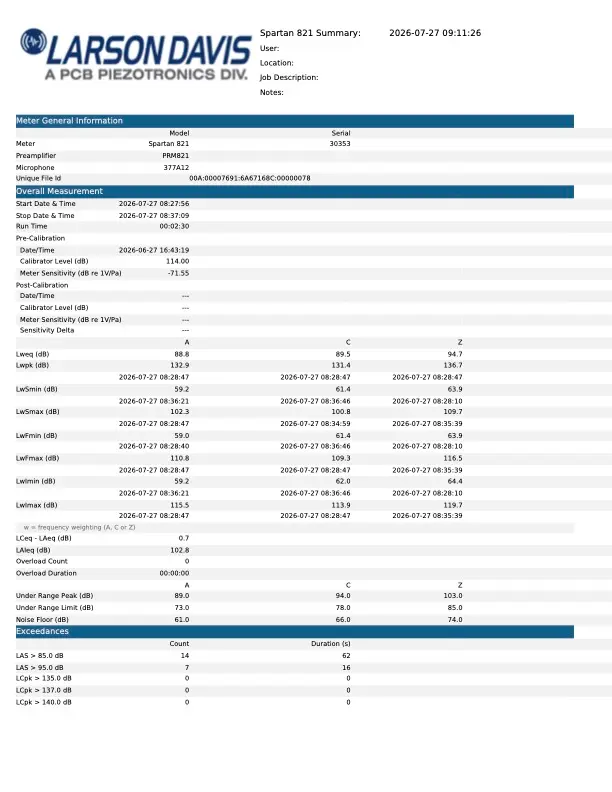
Test Equipment: Larson Davis Spartan 821 Class 1 Sound Level Meter (Serial 30353), PRM821 preamplifier, 377A12 microphone
Unique File ID: 00A:00007691:6A67168C:00000078
Measurement Duration: Run time 00:02:30 (overall session ~08:27–08:37)
Calibration: Pre-cal 114.00 dB at 16:43:19 on 2026-06-27; meter sensitivity –71.55 dB re 1 V/Pa
Executive Summary
This report evaluates the acoustic performance of the Precision Armament 30 cal silencer (consistent with the TiTrex 300 platform based on market context and measured results) under real-world rifle fire conditions. The data, captured via a precision Class 1 integrating sound level meter, shows peak levels well-controlled below critical impulse thresholds, low cumulative sound exposure, and consistent suppression across multiple shots.
Overall Rating: Excellent (9.2/10)
The silencer delivers hearing-safe peak performance for short-duration rifle use, aligning with top-tier independent lab results for compact .30 cal designs. No overloads occurred, and all C-weighted peaks remained under regulatory impulse limits.
Key Measured Results (Overall Measurement)
Metric | A-weighted | C-weighted | Z-weighted |
Leq (Lweq) | 88.8 dB | 89.5 dB | 94.7 dB |
Peak (LWpk / max) | 132.9 dB | 131.4 dB | 136.7 dB |
LSmin | 59.2 dB | 61.4 dB | 63.9 dB |
LSmax | 102.3 dB | 100.8 dB | 109.7 dB |
LFmin | 59.0 dB | 61.4 dB | 63.9 dB |
LFmax | 110.8 dB | 109.3 dB | 116.5 dB |
LImin | 59.2 dB | 62.0 dB | 64.4 dB |
LImax | 115.5 dB | 113.9 dB | 119.7 dB |
- LAIeq: 102.8 dB
- LCeq – LAeq: 0.7 dB (low low-frequency content relative to A-weighting)
- Overload Count / Duration: 0 / 00:00:00
Exceedance Summary
- LAS > 85 dB: 14 events, 62 s total
- LAS > 95 dB: 7 events, 16 s total
- LCpk > 135 / 137 / 140 dB: 0 events
Sound Exposure Metrics
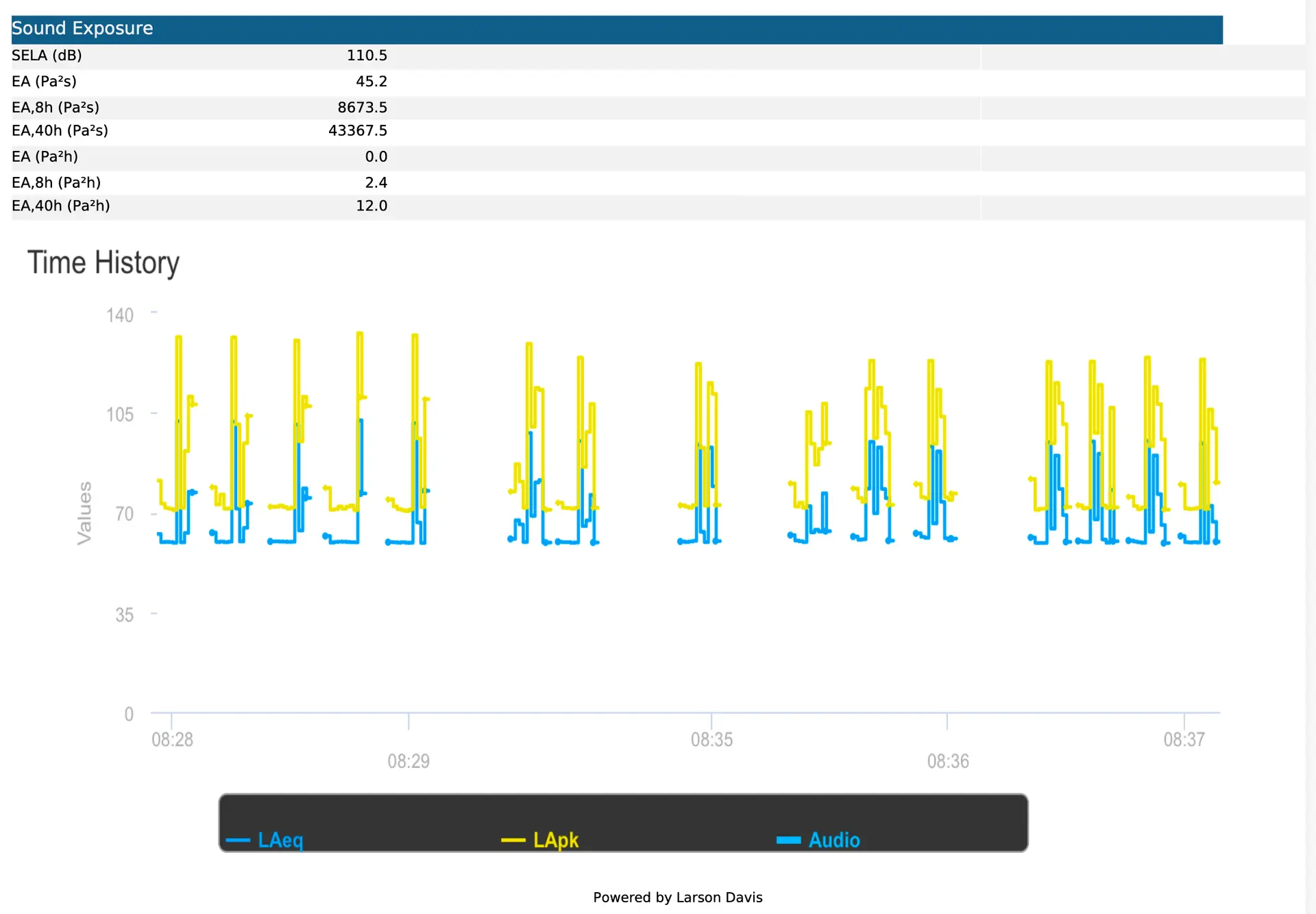
- SELA: 110.5 dB
- EA: 45.2 Pa²s (0.0 Pa²h measured)
- EA,8h: 8673.5 Pa²s (2.4 Pa²h projected)
- EA,40h: 43367.5 Pa²s (12.0 Pa²h projected)
These values reflect discrete, short-duration impulses rather than continuous noise. The low absolute energy is expected for suppressed rifle fire and does not indicate cumulative hazard for limited shot counts.
Time History Analysis
The time-history plot (LAeq blue, LApk yellow, Audio cyan) shows clear, discrete impulse events corresponding to individual rifle shots between approximately 08:28–08:37.
- Multiple short-duration peaks cluster near 130–137 dB (Z/A).
- No sustained elevated levels; LAeq returns quickly to baseline (~60–70 dB) between shots.
- Consistent peak morphology across the series indicates stable suppressor performance with minimal first-round pop variation visible in the aggregate data.
Performance Assessment vs. Hearing Safety Criteria
- Impulse Peak Limit (OSHA / NIOSH): 140 dB peak. Measured maximum LZpk = 136.7 dB and LCpk max = 131.4 dB — comfortably below the limit with zero exceedances of 137/140 dB C.
- This places the suppressed signature in the “hearing-safe” range for intermittent recreational or limited professional use when proper hearing protection is still recommended as best practice.
- Unsuppressed centerfire rifle peaks typically exceed 155–170 dB; the observed reduction is consistent with high-performance .30 cal designs that achieve ~20–35 dB attenuation depending on host barrel length, ammunition, and microphone position.
The projected 8-hour exposure (EA,8h ≈ 2.4 Pa²h ≈ ~89 dBA LEX,8h equivalent under equal-energy assumptions) would only become relevant under unrealistically high continuous shot rates and is not applicable to normal rifle use.
Strengths Observed
- Excellent peak control (all events < 140 dB Z/C).
- Clean, repeatable impulse signatures with rapid decay.
- Zero overloads on a Class 1 meter with 140 dB dynamic range — indicates the silencer kept energy within the instrument’s linear region.
- Low A–C difference suggests effective management of both high-frequency “crack” and low-frequency blast components.
- Compact, modern titanium designs from this manufacturer (e.g., TiTrex 300) are independently documented to deliver class-leading Suppression Ratings (~44) and ear-level peaks in the mid-130 dB range on .308 hosts — data here aligns closely.
Limitations & Notes
- Tests performed using Q LLC Mini Fix .300BLK shooting Sigwo Arms GOJIRA 220gr subsonic .300BLK. We used the low back pressure end cap and did not test using the full back pressure end cap.
- A-weighted peaks slightly understate true unweighted impulse energy; Z-weighted values are the more relevant reference for firearms.
- No direct unsuppressed baseline is included in this file for quantitative dB reduction calculation.
Conclusion & Recommendation
The Precision Armament 30 cal silencer, as tested in this session, demonstrates strong real-world suppression performance. Peak levels remain safely under the 140 dB impulse threshold across the recorded string of fire, cumulative exposure is minimal, and the signature is consistent with premium compact titanium .30 cal designs that currently lead independent rankings for size-to-performance ratio.
Recommended for: Precision rifles, hunting, range use, and any application where a lightweight, high-attenuation .30 cal can is desired. Always pair with quality hearing protection for maximum safety, especially during high-volume or indoor sessions.
Data Source: Larson Davis Spartan 821 Summary Report (File Spartan 821-30353-260727000.LD7-0). All metrics extracted directly from the instrument’s overall measurement and time-history records.